
I worked on a very bizarre customer issue today that I thought I would blog about. I’m curious to see what thoughts people have. I need a new perspective on it since I can’t seem to figure out what to investigate next. Here’s the setup…
The problem was described as a search in one area of our application returned less data than expected, and a search in a different area of the application returned the proper amount of data.
My immediate thought was corruption. I have seen this one other time, where rows existed in the table, and corresponding rows existed in one nonclustered index (IDX1) for the table, but not in the other nonclustered index (IDX2) for the table. In that case, a query that used IDX1 or required a full scan of the table would find the rows, but a query that used IDX2 would not.
This was not the case today. I ran DBCC CHECKDB on the database, everything came back fine. I then dug into the query. I have provided the code for the two involved tables and relevant indexes below. Please note that this is pseudo-code, I am not recreating the exact tables from the customer environment because of confidentiality agreements. Names have been changes to protect the innocent…
{code}
create table dbo.titles (
TitleID int,
name varchar (1000),
releaseyear smalldatetime,
rating varchar(5),
ListID int,
moviestatus int,
runtime small int,
countryID int,
languageID int,
budget int
)
create nonclustered index IDX_titles on dbo.titles (ListID, TitleID, moviestatus)
create table dbo.listings (
ListID int,
ListName varchar(250),
col3 int,
col4 int,
col5 int,
col6 int,
col7 int,
col9 int,
col10 int
)
— yes, I got tired of thinking up pretend column names after a while
create nonclustered index IDX_listings on dbo.listings (ListID)
{/code}
The titles table had about 500,000 rows in it, and stats had been updated on March 11 (four days ago) with 100% sample. The listings table had 250 rows in it, and stats had also been updated with 100% sample on March 11.
When I would run the query below, I would get two rows returned.
{code}
select t.TitleID, t.name, t.releaseyear, t.rating, t.ListID, t.moviestatus,
t.runtime, t.countryID, t.languageID, t.budget, l.ListName
from dbo.titles t
join dbo.listings l on t.ListID = l.ListID
where t.releaseyear between ‘2010-05-01’ and ‘2010-05-31’
and (t.ListID = 1 or t.ListID = 2 or t.ListID = 3
or t.ListID = 4 or t.ListID = 5 or t.ListID = 6
or t.ListID = 7 or t.ListID = 8 or t.ListID = 9
or t.ListID = 10 or t.ListID = 11 or t.ListID = 12
or t.ListID = 13 or t.ListID = 14 or t.ListID = 15
or t.ListID = 16 or t.ListID = 17 or t.ListID = 18)
and t.moviestatus = 1
{/code}
If I removed the join to listings, and the display of the listings.ListName column, all the correct rows would return. The customer is running SQL 2000 SP4, and this was the query plan:

Column statistics existed for the ListID column. Even though I didn’t think it would matter, I dropped them to make sure. No change. Then I decided to drop the IDX_listings index. All the proper rows returned, and my query plan changed to:
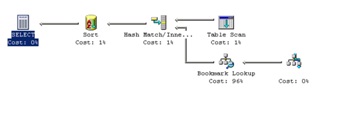
So I’m stumped. I can see that the operator changes from a Merge Join to a Hash Join. In both cases, the optimizer does a table scan of listings. In both cases, there are 240-some rows that come out from that full scan (you can’t see it in the screen shot, but trust me here). In both cases, there are 258 rows that come out of the seek on IDX_titles (that’s the bottom-right seek) and the bookmark lookup. Somehow, in the Merge Join, those 258 rows go down to 2…but in the Hash Join, all 258 come out.
I have no idea what’s going on. Part of me hopes I’m missing something obvious, part of me wonders if it’s a bug. I will post back when/if I get more information…

